

My bio
Roger Beck – My bio
Once upon a time…
1994
Berlin. SGI. The Beginning.
A small company called Neuland in Berlin, Germany, was the starting point of my career. Neuland specialized in SGI-based system solutions, high-speed ATM networks, and dedicated software for the VFX industry, an extremely fast-paced world with the highest demands on real-time data access and near-zero latency.
Collaborating in a non-linear environment, sharing media files and image sequences is a time-critical procedure. High performance and low latency aren’t goals, they’re survival requirements. Working as a Systems Engineer at Neuland, all of this was fascinating to me from day one. I absorbed everything.
1995
Disney. Studio Babelsberg. Lion King II.
My first major assignment: being part of the team setting up a new and innovative studio workflow at Studio Babelsberg in Berlin-Potsdam – a large facility to which Disney/Buena Vista had outsourced parts of the pre- and post-production of The Lion King II: Simba’s Pride. That’s where I truly got my feet wet in post-production studio design.
1996
The First Fully CGI TV Show in Europe — and a Render Manager Nobody Asked For.
After setting up various studios across Germany, I was given the opportunity to join Stardust Entertainment in Berlin-Potsdam — one of the first CGI companies in Germany. The project: building the entire IT infrastructure for Stevie Stardust, the first fully computer-generated TV show in Europe. We are in 1996, by the way.
The expectations were sky-high: state-of-the-art everything, maximum render performance, no existing playbook. Many technologies that go without saying today simply didn’t exist yet. The concept of a render farm was still in its infancy, and a professional render management solution literally did not exist. So I did a lot of R&D — and then I built one myself.
At night and on weekends, I sat down and developed a render management system from scratch. The productivity gains were significant. Then Alias WaveFront got wind of it.
Over the following months, an increasing number of European studios began using render farms – and for reasons I couldn’t fully explain at the time, my software became well-known, particularly in Germany and the UK. Eventually Alias WaveFront (now part of Autodesk) tested it and recommended me and my system to design and post-production studios across Europe.
If anyone finds it notable that Alias WaveFront released their own render management product several months later – I was young, I’d coded in Perl, and I had no patent. I’m not implying anything. But maybe I inspired them at least a little bit.
1999
Founded My Own Company.
With Alias WaveFront’s backing opening doors across Europe, I made the decision to start my own company — offering IT infrastructure planning and design, implementation, network analysis, and troubleshooting. I hired several IT administrators and built a team of 5 around me.
We stayed busy across the continent. The render management software was often the door opener, but it was the depth of technical knowledge and the ability to pinpoint issues fast that kept us engaged, with clients including Siemens, Bosch, Hella Design, and Toyota. More often than not, after finishing the original engagement we’d be asked to come back and train their IT staff as well.
2000
Das Werk. Enemy at the Gates. The Pianist. Roman Polanski.
 In 2000, the largest post-production network in Germany Das Werk landed the contract to post-produce Enemy at the Gates, the WWII epic by Jean-Jacques Annaud. They brought me in as a contractor to design and build the IT network. The project went well, they were satisfied, and they contracted me for ongoing maintenance shortly after.
Early 2001, they asked me to join full-time as IT Team Manager. It was a tough call — letting a prospering independent business go to become an employee again didn’t immediately appeal to me. But Das Werk already had a compelling project slate lined up: The Miracle of Bern and The Pianist, Roman Polanski’s Palme d’Or and Academy Award-winning film. I accepted the contract — and the challenge.
From that point I managed not just the Düsseldorf facility but also their Munich branch, eventually overseeing IT operations across all six locations in Germany: Düsseldorf, Munich, Frankfurt, Hamburg, Cologne, and Berlin. I initiated a VPN mesh between all locations, established unified IT standards across the company, streamlined staff education, and rebuilt the infrastructure to handle the demands of large-scale CGI post-production.
2004
CIO. 27 People. $200K Saved. One Project.
Das Werk was renamed Pictorion Das Werk, and I was promoted to CIO of all branches. 27 team members. Reporting directly to the board.
Between 2004 and 2007, I achieved overall cost savings of around $200,000 from a single project. The idea was straightforward once you saw the problem: instead of spending 50 render nodes per branch and leaving most of them idle, I proposed centralizing the render farm. A blade server-based farm connected via the VPN mesh, transparent to all users across the network.
Result: the farm dropped from 300 nodes to 150, while average utilization climbed to 90%. Half the hardware cost. Significantly lower power consumption and cooling overhead. A separate project, a software license management system allowing artists to check licences in and out on demand rather than owning per-seat copies, further reduced both capital costs and annual maintenance fees across 150 workstations.
This is where I learned that the most powerful infrastructure improvements aren’t always the most technically complex. Sometimes the best engineering is just clear thinking applied to the right problem.
2007
Bright Technologies. Eight Years. Engineer to Director.
Ready for a new challenge after reaching the limit of what felt achievable at Pictorion Das Werk, I made the move to the U.S. and joined Bright Systems Inc. in Reno, NV — leading their first international entity out of Hamburg, Germany.
My background as a former customer was immediately valuable: I understood infrastructure challenges from both sides of the table. Within months I was promoted to Technical Service Group Manager EMEA , building out my team, training the reseller channel, and qualifying partners for first-level technical support. A year later, another promotion: Technical Service Group Manager Worldwide.
That promotion meant relocating to Reno in 2009. In mid-2010, Bright Systems made an unfortunate strategic pivot that ultimately led to bankruptcy. The core technical team regrouped and founded Bright Technologies, and I stayed with them through the rebuild, becoming their Director of Technology.
As Director, I managed both the technical service department and all pre-sales activities. I stayed close to hands-on troubleshooting – not out of necessity, but because I believe that operational depth is the only credible foundation for leadership. I also drove product innovation by staying in direct contact with customers and monitoring competition closely.
2015
Hollywood Calls. The Revenant. Avengers. Doctor Sleep.
After eight years with Bright, I accepted an offer to join the media and entertainment division of Rohde & Schwarz in Los Angeles as a Senior Solutions Architect. That led to ELEMENTS wooing me away as Director of Solutions Architecture in 2016, where I launched and grew the company’s entire U.S. presence from scratch.
Throughout this period, people in the industry kept finding me for complex media workflow challenges they hadn’t been able to solve elsewhere. Since I’ve always loved the hands-on work and the challenge of pushing for better solutions, I spent my spare time helping friends across some of Hollywood’s most technically demanding productions.
The projects came through relationships built over years, not contracts, not agencies. Just trust, reputation, and a phone call from someone who knew I’d figure it out.
2022
A Technical Emmy. FIFA World Cup. Fox Sports.
As a personal crew member of the Fox Sports broadcast team for the FIFA World Cup 2022, I was part of a team recognized with one of the most prestigious honors in broadcast engineering.

A Technical Emmy recognizes outstanding achievement in broadcast engineering, the systems, infrastructure, and people who make live television at the highest level of scale work flawlessly. This one has my name on it. It represents the moment when a 30-year journey from a Berlin studio to the world’s biggest sporting broadcast came full circle.
2025
The Wizard of Oz at Sphere. Then: DataCore. Always: What’s Next.
Before the year began, I contributed to The Wizard of Oz at Sphere in Las Vegas, arguably one of the most technically ambitious immersive entertainment experiences ever built. The Sphere is a category of its own: the infrastructure requirements for that level of resolution, synchronization, and real-time delivery are unlike anything else in the industry.
In November 2025, I joined DataCore Software as Senior Solutions Architect. A deliberate step outside the M&E workflow world, and into enterprise storage at scale: block, object, Kubernetes-integrated storage, and AI-driven, data-intensive architectures. The file, the asset, the blob, the container, different words, same fundamental challenge. I’ve been solving it since 1994.
What drives me has never changed: the more complex the environment, the more interesting the problem. And there is no shortage of interesting problems right now.
Some engineers explain things with slides. I use diagrams, stories, analogies — and occasionally one so good it ends the meeting early.
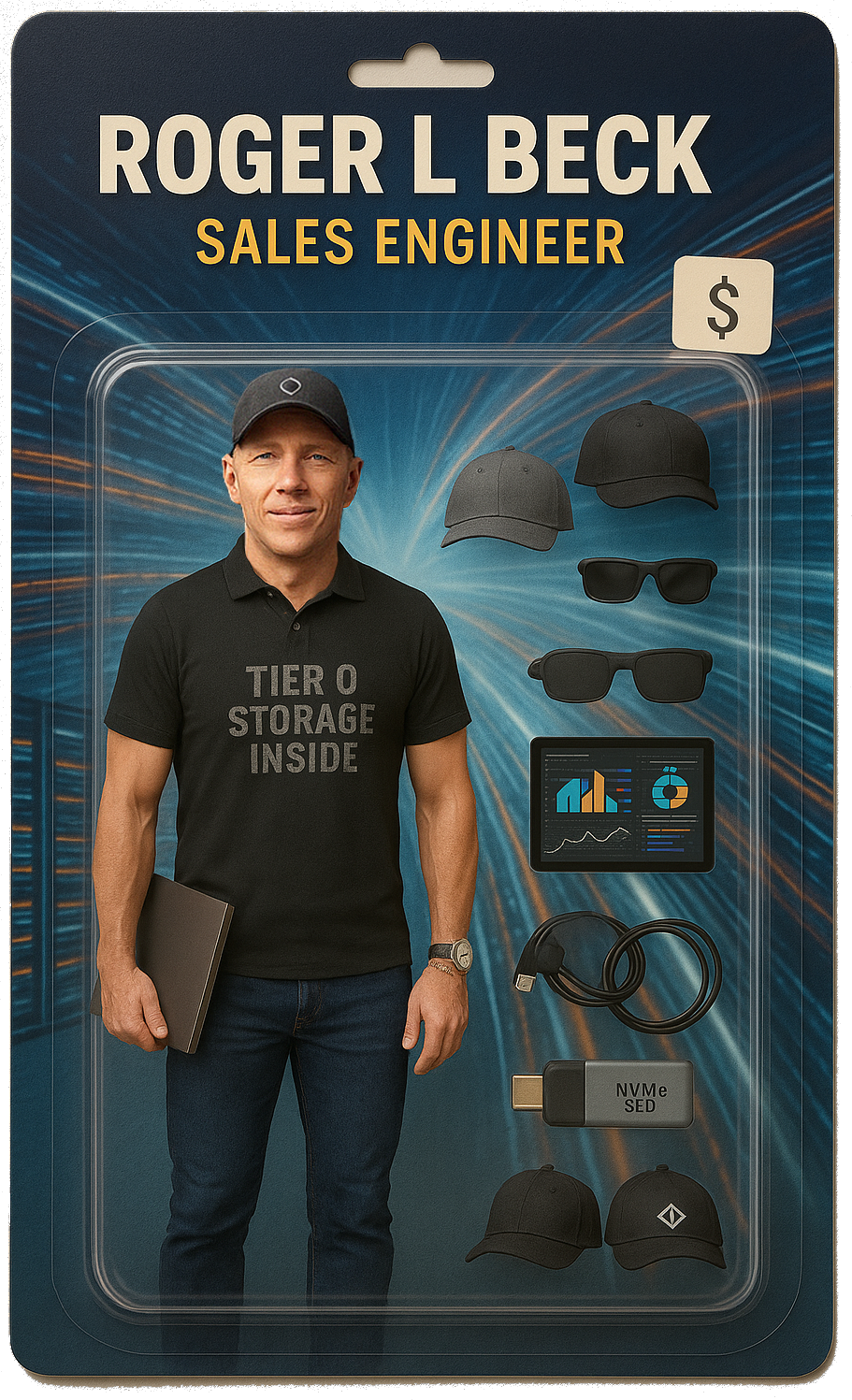
I’m a Senior Solutions Architect and Sales Engineer who has spent the better part of two decades helping enterprise teams make sense of their most difficult infrastructure challenges — unstructured data, AI/ML storage pipelines, hybrid cloud architectures, and the workflows that hold all of it together.
I’ve built teams, founded a consultancy, held a CIO title before most people knew what one was, and spent years in the field with clients who don’t have time for vague answers or oversold technology. That shaped how I work: direct, honest, and always focused on the outcome rather than the process.
“I’m not just pre-sales. I’m pre-trust.”AND THAT MAKES EVERYTHING THAT FOLLOWS GO SMOOTHER.